

 By
By Ghana’s mining sector has demonstrated remarkable resilience and evolution, solidifying its role as a fundamental pillar of the national economy. Gold, as the primary mineral, has driven substantial increases in fiscal revenue and export earnings. Despite some challenges such as illegal mining which the government is working to address, Ghana’s abundant mineral resources and its proactive policy adjustments present compelling opportunities for sustainable investment and integrated value chain development.
Historically, the industry’s focus has primarily centered on four key minerals: gold, diamonds, manganese, and bauxite, owing to their significant economic impact and established production infrastructure. Large-scale mining operations are predominantly managed by foreign entities, with the government of Ghana holding a 10% free carried interest in most of these operations. Conversely, small-scale mining activities are exclusively reserved for Ghanaian citizens, ensuring local participation and economic empowerment within the sector.
For the first three quarters of 2024, the mining and quarrying sub-sector demonstrated strong average growth of 15%, with the third quarter alone registering an impressive 17.1% growth. In 2024, dividends paid to the state from mining operations surged by over 600%, reaching GH¢1.03 billion. The mining sector’s share of direct domestic taxes also increased, rising from 22.7% in 2023 to 24.3% in 2024. Similarly, its overall contribution to domestic revenue grew from 8.8% to 9.6%, and its share of total government revenue rose from 8.6% to 9.5% over the same period. Mineral royalties, a key component of fiscal revenue, experienced substantial growth, climbing by 76.7% from GH¢2.8 billion in 2023 to GH¢4.9 billion in 2024.
In recent years, the government of Ghana has embarked on reforms designed to enhance the capture of value from mineral resources, promote local content, and address pressing environmental concerns. This strategic reorientation is expected to lead to increased domestic processing capabilities, stimulate local job creation, and generate higher revenue per unit of mineral extracted.
GOLD
Ghana’s gold sector is the preeminent force within its mining industry, consistently maintaining its status as a leading producer in Africa. Ghana re-established its position as Africa’s top gold producer in 2023, with national gold output increasing by 32% to 3.7 million ounces, up from 2.8 million ounces in 2021. For 2024, gold production reached 4.3 million ounces, generating a substantial US$11.6 billion. Asia continues to be the primary importer of Ghanaian gold, followed by Europe and the UK.
The newly established Ghana Gold Board, operational since early 2025, is poised to transform this vital segment of the industry. GoldBod’s mandate includes centralising gold purchase and trade, combating illegal trade, enhancing transparency, and ensuring the gold sector contributes directly to GDP growth.
BAUXITE
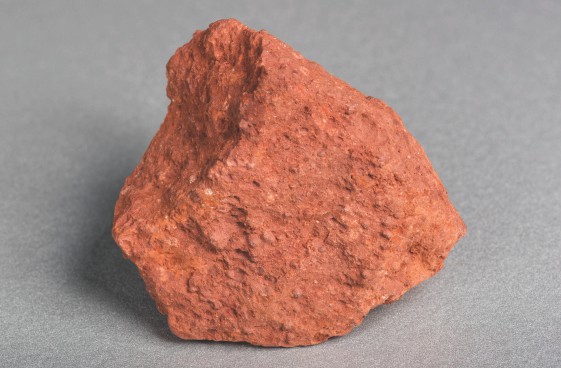
Ghana’s bauxite industry is undergoing a significant transformation, with a strong national commitment to developing an integrated aluminium value chain. Production reached 3.3 million metric tonnes (MT) in 2024, accounting for a 2.4% share of total African production. The Ghana Bauxite Company has articulated plans to ramp up its production to 2 million MT annually. Significantly, plans were announced in June 2024 to introduce a law that would ban the export of raw bauxite, with a view to the monetisation of Ghana’s estimated 900 MT of bauxite reserves, enhancing downstream and midstream infrastructure development, and ultimately increasing national revenue through the export of higher-value bauxite products.
The Awaso mine, one of the country’s oldest mining areas, holds estimated reserves of 60 million MT. The Nyinahin deposit in the Ashanti Region contains Ghana’s largest bauxite reserves, estimated at 700 million MT, with a mineral resource estimate in 2023 revealing a 50% surge in these deposits. Additionally, the Kyebi deposit in the Eastern Region holds approximately 160 million MT of reserves and is slated for future development.
MANGANESE
Manganese production in Ghana reached 5.10 million MT in 2024, with a robust compound annual growth rate (CAGR) of 15% between 2021 and 2024. In 2023, Ghana was the fourth largest exporter of manganese ore globally, holding a 7.6% share of total exports. This represents an improvement from previous rankings, indicating Ghana’s growing prominence in the global manganese market. The Ghana Manganese Company (GMC) remains the sole manganese producer and exporter in Ghana, operating with a legacy spanning over a century. Despite holding a long-term mining concession covering 170 sq km, less than 3% of this area has been mined to date, indicating vast untapped potential.
DIAMONDS
Ghana’s diamond sector, which has historically faced significant challenges, is now showing signs of recovery, primarily driven by the activities of small-scale miners. The country’s exports have experienced a significant resurgence in recent years. From October 2023 to September 2024 Ghana exported 285 shipments of diamonds, marking a substantial 52% growth compared to the preceding twelve months. In 2024, diamond exports reached 332,307.52 carats, an increase from 202,757.13 carats in 2023. The total export value for 2024 stood at US$15.30 million.
The Ghana Consolidated Diamond Limited (GCDL), now known as Great Consolidated Diamonds Ghana Limited (GCD Gh Ltd), was taken back into state ownership in 2019 and large-scale mining has been suspended while it undergoes strategic rehabilitation. Consequently, the large-scale diamond sector is exclusively dominated by artisanal producers. Despite the suspension of mining operations, GCD Gh Ltd has embarked on a rehabilitation of the entire plant.
SECTOR OPPORTUNITIES
- Companies to exploit the extensive deposit of granite to produce high-quality floor tiles.
- Provision of support services to mining companies in the country, such as contract drilling, assay laboratories, contract mining, and geological consultancies.
- Companies to set up manufacturing plants and machinery for the mining industry.
- Companies to set up downstream production facilities to manufacture key input for the mining industry (mill balls, drill bits, cyanide, and activated carbon).
- Public–private partnership for the establishment of an aluminium smelter.
- Development of three new bauxite mines.
- Setting up refinery facilities to serve the local industry for value-added products.
- Companies to manufacture clinker for the mining industry (clinker demand is estimated to be more than one million MT per year).
- Development of Ghana’s diamond industry.
- Development of Ghana’s iron and steel reserves.
INVESTMENT INCENTIVES
- Mining companies get concessionary rates for the import of plant, machinery, and equipment meant purposely for mining.
- In addition, mining companies enjoy a capital allowance of 20% straight line on mining assets for five years and an investment allowance of 5% in the first year.
- Ghana’s main resources include gold, diamonds, manganese, and bauxite, but the country also has untapped reserves of iron ore, copper, chrome, nickel, limestone, quartz, and mica.
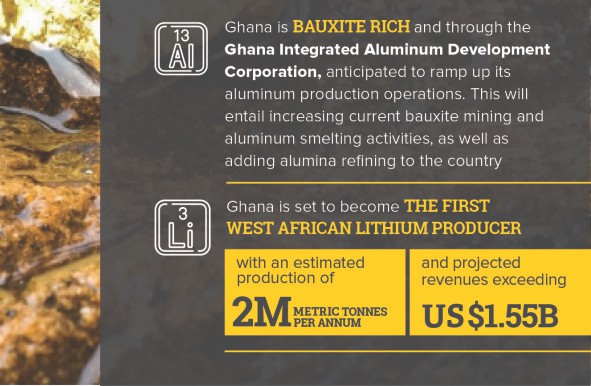
Source: https://gipc.gov.gh/wp-content/uploads/2023/03/Mining-Spotlight-Brochure-4.pdf: pp3




Comments