

 By
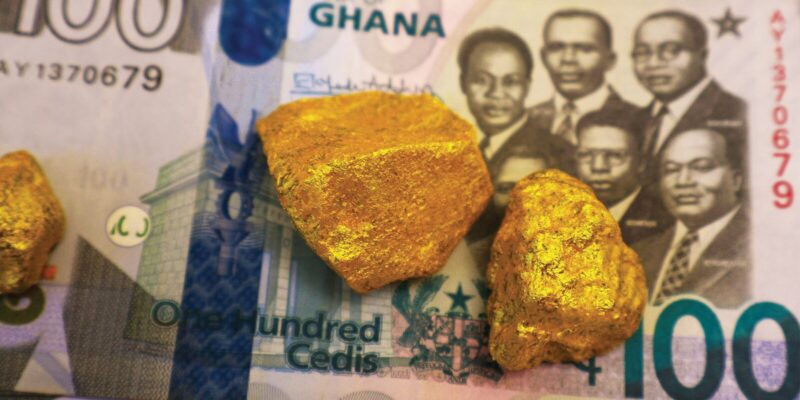
Ghana’s mining sector is a fundamental pillar of the national economy, historically centred on four minerals: gold, diamonds, manganese, and bauxite.
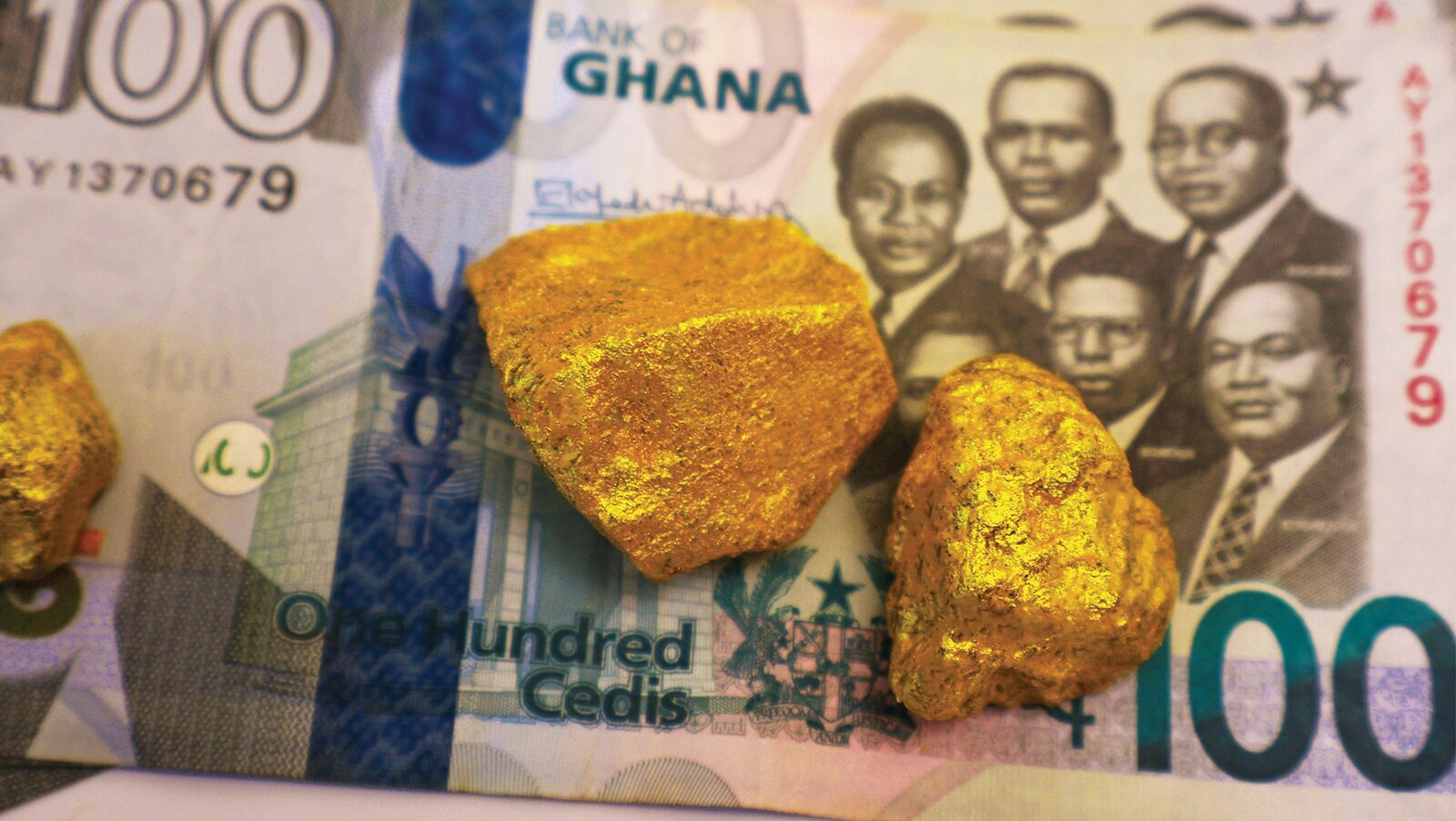
Large-scale operations are predominantly run by foreign companies, with the government holding a 10 per cent free carried interest in most, while small-scale mining is reserved for Ghanaian citizens. From 2026 lithium becomes a fifth pillar, with the ratification of Ghana’s first lithium mining lease.
Recent reforms aim to capture more value from mineral resources, promote local content and address environmental concerns, with the goal of more domestic processing, local jobs, and higher revenue per unit of mineral extracted.
NATIONAL GOLD OUTPUT REACHED A RECORD 6 MILLION OUNCES IN 2025, A 25 PER CENT RISE, WITH ARTISANAL AND SMALL-SCALE PRODUCTION CLIMBING FROM 1.9 MILLION TO 3.1 MILLION OUNCES.
GOLD
Ghana’s gold sector is the preeminent force within its mining industry and the country has widened its lead as Africa’s largest producer. National output reached a record 6 million ounces in 2025, a 25 per cent increase on the previous year, and government is targeting 6.5 million ounces in 2026. The composition of that growth is as significant as its scale: artisanal and small-scale mining produced 3.1 million ounces, up from 1.9 million, while industrial output held broadly flat at 2.9 million ounces. For the first time, formalised small-scale production accounts for more than half of Ghana’s gold.
Export earnings have risen even faster, reflecting both volume and an exceptional gold price. Gold exports were on course for approximately US$20.9 billion across 2025, against roughly US$10.3 billion the previous year. Asia continues to be the primary importer of Ghanaian gold, followed by Europe and the UK.
The Ghana Gold Board (GoldBod), operational since early 2025, has been the instrument of that change. GoldBod centralises gold purchase and trade, with a mandate to combat illegal trade and improve transparency. In its first year it independently exported a record 100 tonnes of gold, contributing around US$10 billion to the national export total, redirecting into official and taxable channels production that was previously lost to smuggling. The Bank of Ghana has meanwhile been accumulating bullion, raising physical holdings from 18.6 tonnes at the end of 2024 to 22.3 tonnes by April 2025. New industrial capacity is also coming on stream, with Newmont’s Ahafo North mine entering production in September 2025 at an annual capacity of 275,000 ounces.
A NEW FISCAL REGIME
Investors should note a material change to mining fiscal terms. The Minerals and Mining (Royalty) Regulations, 2025 came into force in March 2026, replacing flat royalty rates with a sliding scale indexed to the commodity price. For gold, the scale runs from 5 per cent at prices up to US$1,900 per ounce, to 6 per cent above US$2,000, and to 12 per cent where the price exceeds US$4,500 per ounce. The scale applies across mineral commodities, including lithium. Three companies operating under existing stability agreements, Zijin, AngloGold Ashanti, and Gold Fields, are outside the new regime.
Government’s stated rationale is that the state should capture the benefit in strong markets while companies are automatically protected when prices fall. Industry has pressed for a lower ceiling, and parliament reduced the Growth and Sustainability Levy to cushion the combined burden. The design is symmetrical and price-linked rather than a flat increase, which is the distinction investors modelling Ghanaian assets will care about most.
LITHIUM
In March 2026 parliament ratified the mining lease for the Ewoyaa lithium project, the first lithium lease granted and ratified in Ghana, and the country’s entry into the battery minerals supply chain. The lease runs for an initial 15 years and is renewable, with fiscal terms revised to align with current legislation including a sliding-scale royalty for lithium. The project is held by AIM-listed Atlantic Lithium, which is being acquired by China’s Huayou Cobalt in a transaction valued at around US$210 million. That deal received Australian foreign investment clearance in September 2026 and remains subject to a shareholder vote and court approval, with completion expected around the end of the year. Further project financing is still to be secured before construction begins. For investors, Ewoyaa establishes the legal and fiscal precedent under which every subsequent lithium project in Ghana will be negotiated.
BAUXITE
Ghana is committed to developing an integrated aluminium value chain. It holds estimated bauxite reserves of some 900 million tonnes: around 700 million tonnes at Nyinahin in the Ashanti Region, approximately 160 million tonnes at Kyebi in the Eastern Region, slated for future development, and 60 million tonnes at Awaso, one of the country’s oldest mining areas.
Ghana Bauxite Company lifted output to 1.8 million tonnes in 2024 from 1.3 million tonnes previously, and has committed some US$123 million to mining equipment in pursuit of a substantially higher production target. Government has signalled a law to ban the export of raw bauxite, with a view to monetising reserves through downstream and midstream infrastructure and ultimately increasing national revenue through the export of higher-value products. The Ghana Integrated Aluminium Development Corporation is a partner in the Tema Integrated Industrial Park, an 83.5-hectare development that broke ground in July 2026 that includes integrated aluminium processing among its target activities.
MANGANESE
Manganese production in Ghana reached 5.10 million tonnes in 2024, with a compound annual growth rate of 15 per cent between 2021 and 2024. Ghana ranked as the fourth largest exporter of manganese ore globally, holding a 7.6 per cent share of total exports. The Ghana Manganese Company remains the sole manganese producer and exporter in the country, operating with a legacy spanning over a century. Despite holding a long-term mining concession covering 170 square kilometres, less than 3 per cent of this area has been mined to date, indicating vast untapped potential.
DIAMONDS
Ghana’s diamond sector, which has historically faced significant challenges, is showing signs of recovery, primarily driven by the activities of small-scale miners. In 2024 diamond exports reached 332,307 carats, an increase from 202,757 carats in 2023, with a total export value of US$15.30 million. Great Consolidated Diamonds Ghana Limited, taken back into state ownership in 2019, has suspended large-scale mining while its entire plant is rehabilitated, leaving the sector dominated by artisanal producers.
SECTOR OPPORTUNITIES
- Companies to exploit the extensive deposit of granite to produce high-quality floor tiles.
- Provision of support services to mining companies in the country, such as contract drilling, assay laboratories, contract mining, and geological consultancies.
- Companies to set up manufacturing plants and machinery for the mining industry.
- Companies to set up downstream production facilities to manufacture key inputs for the mining industry (mill balls, drill bits, cyanide, and activated carbon).
- Public–private partnership for the establishment of an aluminium smelter.
- Development of three new bauxite mines.
- Setting up refinery facilities to serve the local industry for value-added products.
- Companies to manufacture clinker for the mining industry (clinker demand is estimated to be more than one million tonnes per year).
- Development of Ghana’s diamond industry and iron and steel reserves.
- Lithium exploration, and downstream processing and battery-materials capacity, on the fiscal precedent now set by Ewoyaa.
- Service and financing provision to the formalised small-scale gold sector, which now produces more than half of Ghana’s gold through GoldBod’s official channels.
INVESTMENT INCENTIVES
- Mining companies get concessionary rates for the import of plant, machinery, and equipment meant purposely for mining.
- Mining companies enjoy a capital allowance of 20 per cent straight line on mining assets for five years and an investment allowance of 5 per cent in the first year.
- Royalties adjust downward automatically when commodity prices fall, giving projects protection through the cycle rather than a fixed obligation. ■TG
Source: https://gipc.gov.gh/wp-content/uploads/2023/03/Mining-Spotlight-Brochure-4.pdf pp3





Comments